Global by Construction
5.1 The Three-Layer Stack
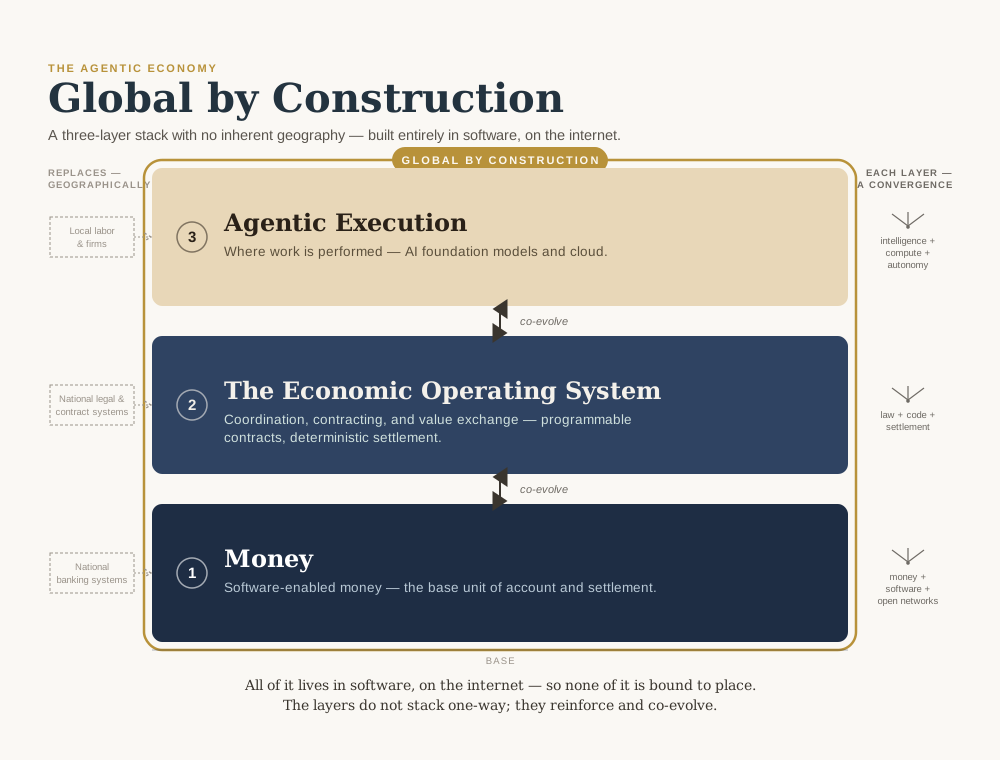
The agentic economy has a concrete architecture, and that architecture has three layers. At the base sits money: software-enabled money, in the form of stablecoins, serving as the unit of account and the medium of final settlement. Above it sits an economic operating system: the layer of coordination, contracting, and value exchange, realized as blockchains and programmable smart contracts with deterministic settlement finality. At the top sits agentic execution: the layer where work is performed, powered by AI foundation models and the cloud software through which they act. The decisive fact about all three is not what they do but where they live. Each is software. Each runs on the internet.
Each layer matters because of what it replaces. Money as software supplants the national banking systems that have intermediated economic life for centuries: national to their core, stitched across borders only through slow and costly correspondent banking. Software-enabled money has no such edges. It is the same money everywhere it is held, settling without asking which country the counterparty inhabits.
The economic operating system replaces the national legal and contract-enforcement systems through which strangers have historically transacted at all. Coordination and trust have always been jurisdiction-bound, because the courts and registries that make a contract mean something are bound to a sovereign. A programmable settlement layer relocates that function into deterministic code, executing identically wherever the parties sit. The trust derives from the protocol, not from a jurisdiction.
Agentic execution replaces the most geographically rooted thing of all: local labor and the firms that organize it. Execution performed by AI models in the cloud has no hometown. It can be summoned from anywhere, by anyone, at any scale, answering to demand rather than location.
This is the organizing insight. Each layer, on its own, has no inherent geography, because each lives in internet software rather than in any national institution. So the economy assembled from them inherits, by default, the borderlessness of the internet. This is global by construction: not a feature added to the system but a structural property of what it is made of. For all of recorded economic history, the substance of economic life has been native to nations and only ever retrofitted onto cross-border ambitions. Now that substance is natively global, and the national framing is the thing that must be retrofitted back on.
The three layers are not a strict bottom-up stack in which each merely rests on the one below. They are interdependent and co-evolving, each accelerating the others. Money makes execution transactable. Execution drives demand for coordination. Coordination makes money useful, giving the unit of account something to denominate. Each layer is itself a convergence of maturing technologies arriving at once (cryptographic settlement, programmable contracts, foundation models, ubiquitous cloud): the signature of a platform shift rather than a single invention.
Once the economy is native to the internet rather than to any nation, a cascade of questions opens that the older framing never had to ask. What does it mean for an economy to have no native jurisdiction? What must money become when it spans every currency at once rather than rests within one? How do sovereignty and compliance reassert themselves against a system that does not recognize borders, and what new forms must they take? And what is the nature of an economy that is at once radically equalizing and powerfully concentrating? The architecture is clear. Its implications are not, and the rest of this section turns to them.
5.2 No Single Native Jurisdiction
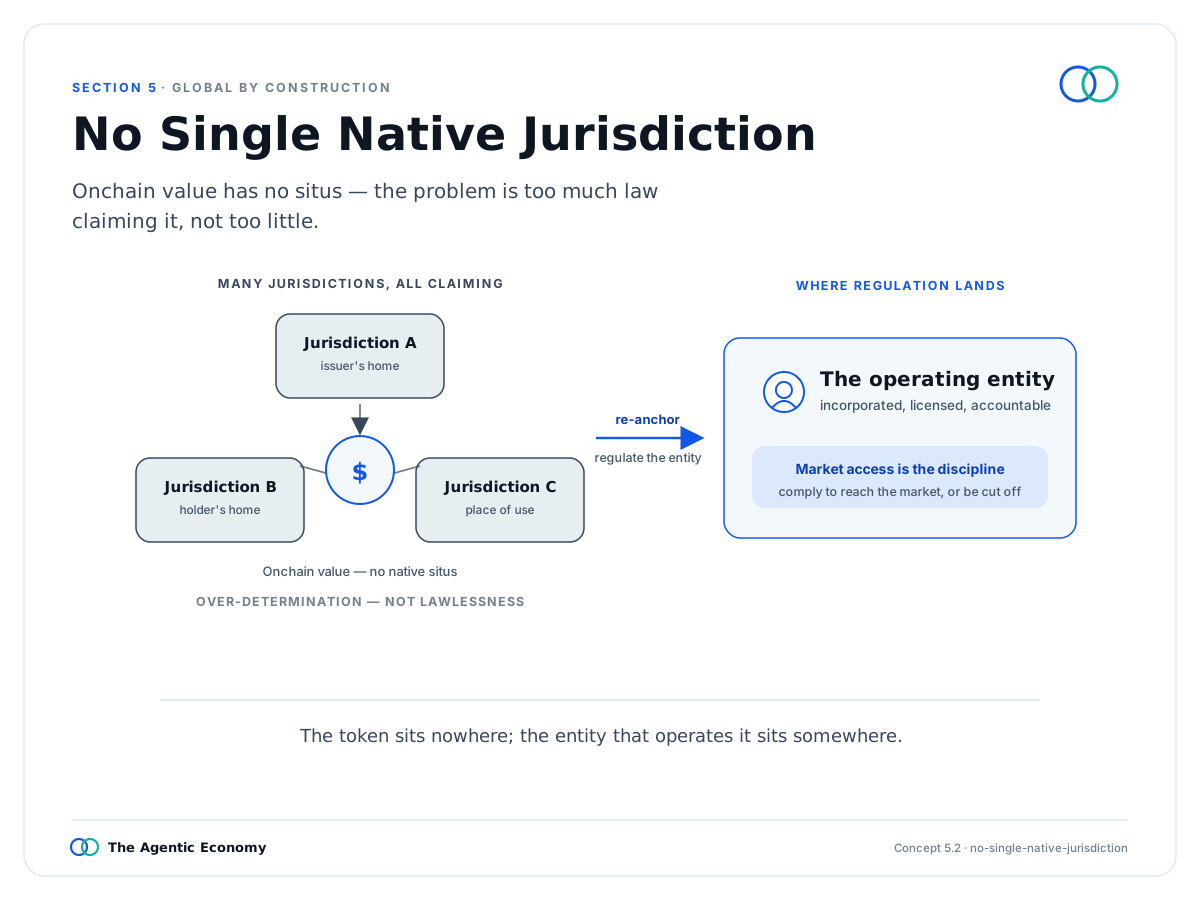
Every economy that has ever existed has been situated somewhere. Cross-border regulation rests on a premise rarely examined because it was rarely false: an economic act occurs somewhere in particular, performed by a party domiciled somewhere in particular. The act has a situs, a legal location, and from that situs flows the question of which sovereign's rules apply. The agentic economy is the first economy whose substance has no native situs at all. The reason is the work itself: it is executed, yet not necessarily human work, performed by software agents whose creators may be spread across a dozen jurisdictions, drawing on models trained in one place, hosted in another, invoked by a counterparty somewhere else. When such an agent negotiates a price or settles a payment, the classical question (where did this happen?) has no answer.
It is tempting to call this a jurisdictional vacuum, but the opposite is true. The act without a situs does not escape law. It falls under too much of it. Modern conflict-of-laws long ago stopped requiring a physical location; mandatory rules attach by effect and by the protected party's position, wherever the actor sits. An agent assembled by contributors in twelve countries is potentially subject to the consumer-protection law of the customer's residence, the data law of the data subject, and the tax claim of the market all at once, and sometimes these may conflict. The structural fact is not the absence of applicable law but the collision of too many claims to it, with no situs left to break the tie. The economy has no single native jurisdiction.
The obsolescence of situs arrives alongside a better coordinate. Every agent is bound to an accountability chain: it acts through credentials and a wallet that trace, through an identity and trust stack, to a real-world creator or entity that has been verified and stands in good standing. Autonomy is not anonymity. Set against the world it succeeds (correspondent banking, nominee structures, offshore vehicles, where the beneficial party is exactly what cannot be seen), this economy is far more legible. Here, every actor resolves to someone accountable.
So if the location of an act can no longer organize regulation, the accountable entity behind it can. The question shifts from a territorial one to an entity-based one: who is the accountable party standing behind this agent, and what obligations does it carry? But entity-based regulation is not standard-free regulation. If accountability attaches to an entity rather than a place, the entity will choose the place, and "verified in good standing" can decay into "verified somewhere that asks no hard questions."
The discipline must come from the demand side: the jurisdictions where users actually sit conditioning market access on the operator meeting a recognized substantive floor. This is how data regulation already reaches the world, and how recent tax accords answered situs-less digital value.
Two limits keep this from being so straightforward. First, attribution is not enforcement. Tracing an act to a verified entity yields a name, not a remedy, and a party domiciled beyond reach can sit behind a perfect identity record. What changes is that, when value moves on programmable rails, enforcement can attach at the level of the infrastructure rather than the courtroom: credentials revoked, balances frozen, access conditioned on compliance. This lever is faster than litigation, and double-edged, because it concentrates enforcement power in whoever operates the infrastructure (a matter taken up later, and one that already has stirred controversy in onchain markets).
Second, the identity layer that makes the economy accountable is, from the other side, a mechanism of control. An accountability engine and a censorship engine can be the same machine. So the identity layer cannot be a single global registry run by a single operator. It must be plural and portable: competing issuers, user-held credentials, selective disclosure so "verified" can be proven without exposing identity to every counterparty, and real due process around revocation. Designed that way, traceability serves accountability without becoming surveillance. The architecture is a choice, and it has to be made deliberately.
5.3 Compliance at the Edge
Here's the plainer version, straight paragraphs, no sub-headers.
Every system the world has built to fight illicit money rests on a quiet assumption: that money moves slowly, and through few enough chokepoints, to be inspected after the fact. A wire crosses borders through a chain of correspondent banks, each seeing only its own leg. A suspicious-activity report gets filed days later. The old architecture is opaque, fragmented, and backward-looking by design. Its defenders have mistaken that opacity for safety.
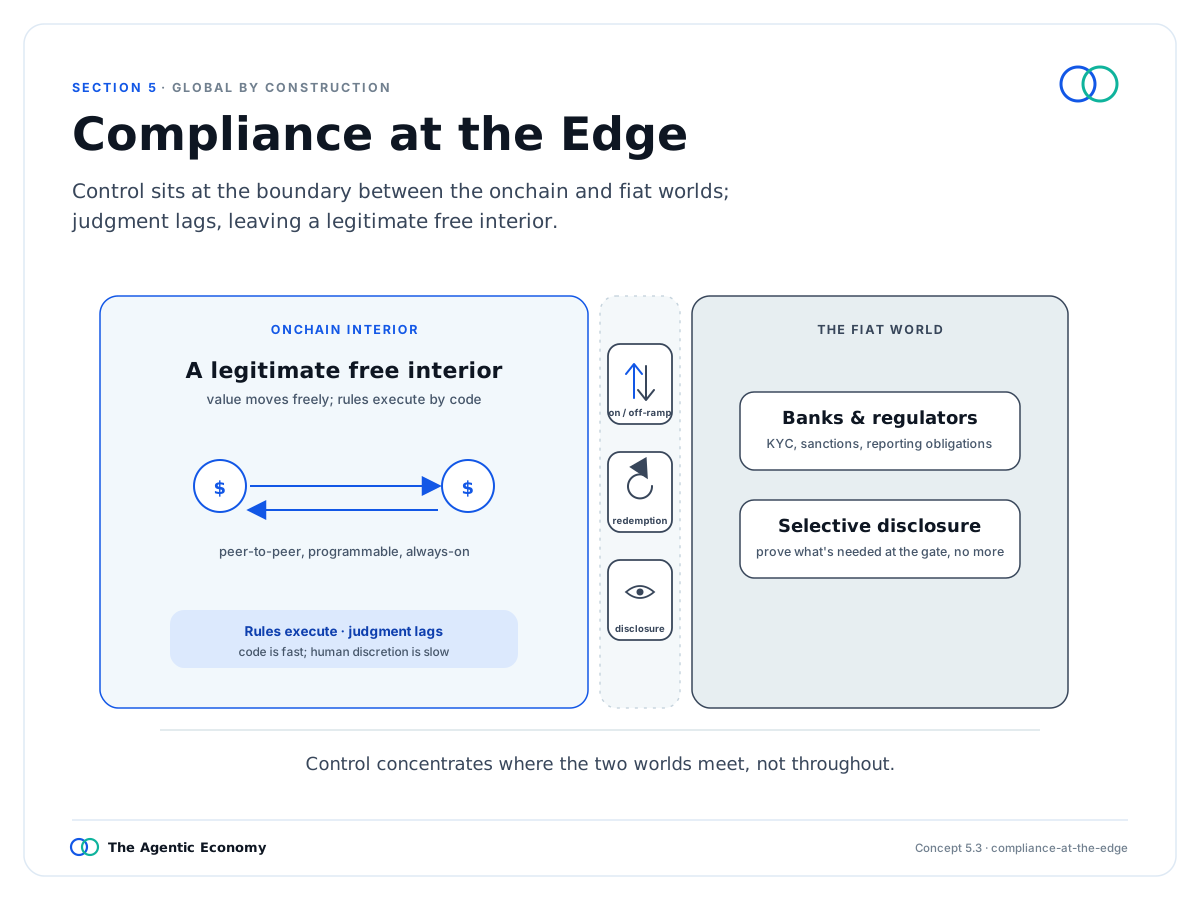
The agentic economy makes control stronger at the points that matter most: onboarding, moving money into the system, and moving it across the line of the regulated world. Those are exactly where the old system fails, and it fails on visibility and timing, which is what a transparent, identity-rooted, programmable settlement layer fixes. Screening can be built into the rails themselves, not bolted onto each middleman. It runs as a gate before a transaction settles, not a report after it clears. An agent acts through credentials that trace back to a verified entity, so you can always get from a transaction to a nameable party, which is rarely true across the correspondent maze. And programmable infrastructure gives you levers the old rails never had: revoking credentials, freezing or returning balances, and conditioning access on compliance.
None of this requires publishing everyone's financial life on an open ledger. The answer is selective disclosure: a system that's private by default and discloses only by consent, granting read access through cryptographically enforced, permissioned rules. Supervisors and law enforcement get authenticated visibility into what they're authorized to see. Competitors and the public see nothing.
But one distinction matters. Programmability guarantees that rules run at machine speed. It does not guarantee that judgment keeps up. Enforcing known rules in real time is genuinely new and powerful. Detecting new kinds of illicit activity in real time is a hard, adversarial problem, and machine speed makes it harder, because agents can probe a ruleset faster than humans can close the gap between the rule and its intent. So laundering isn't solved. Prevention at the boundary gets cheap and fast. Detection on the inside stays an arms race, better-instrumented than today but not won.
This is the crux, and it's a question of architecture, not surveillance. A legitimate financial system has to leave room for real economic freedom and hard privacy: self-custody, unhosted wallets, transfers no operator can see or stop. That isn't a gap to be closed. It's a legitimate condition of a free society, the digital version of cash, and any standard that tried to abolish it would be building an apparatus of total control. The right approach is to put policy at the edge, at the boundary where value and identity cross from the regulated world into the free interior and back. You regulate the on-ramps and off-ramps, not the wallet itself. Illicit value is only useful once it's converted into real purchasing power, and that conversion almost always means crossing back into the transparent world, where issuer redemption is an observable chokepoint that cash never had.
The base layer has to preserve full freedom of use while each jurisdiction builds its own controls at the edges. Build centralized control into the foundation, and you've created a single set of levers that can be captured, coerced, or misused. A neutral base layer is, by design, not something you can sanction. Recent law has started to recognize this, where authorities tried to sanction ownerless protocol code rather than the people using it. Control belongs at the credentialed edge, not in the neutral core.
The hardest capability to defend is also the most powerful. The same lever that returns a thief's takings can enable wrongful seizure, automated error at scale, and state-coerced censorship of lawful but disfavored actors. A freeze that's instant and global, applied by an issuer under pressure with no court involved, is a worse instrument of liberty than the banking freeze it replaces. Freeze and clawback are legitimate only when wrapped in real due process: cryptographically logged, set to expire unless a court renews them, requiring multiple parties to authorize, and paired with a genuine right of appeal.
So the architecture forces a value choice, and it should be made in the open. A bounded private interior means some illicit value will live beyond direct reach, as it always has with cash. What the architecture offers isn't total visibility. It's proportionality. The state gains stronger tools than it has today, observable boundaries, screened on-ramps and off-ramps, and due-process-bound enforcement at the edge, in exchange for giving up the dream of a panopticon over the interior.
5.4 Multi-Currency Money and Invisible FX
Foreign exchange is the friction-laden seam between national curencies, and almost everything slow and expensive about moving value across borders lives in that seam. A cross-currency payment threads a chain of correspondent banks, each pre-funding accounts in the other's currency, each taking a margin, each adding a day. The agentic economy dissolves the seam by dissolving its premise: that each currency lives in its own national plumbing and must be handed across the border by intermediaries who straddle two systems.
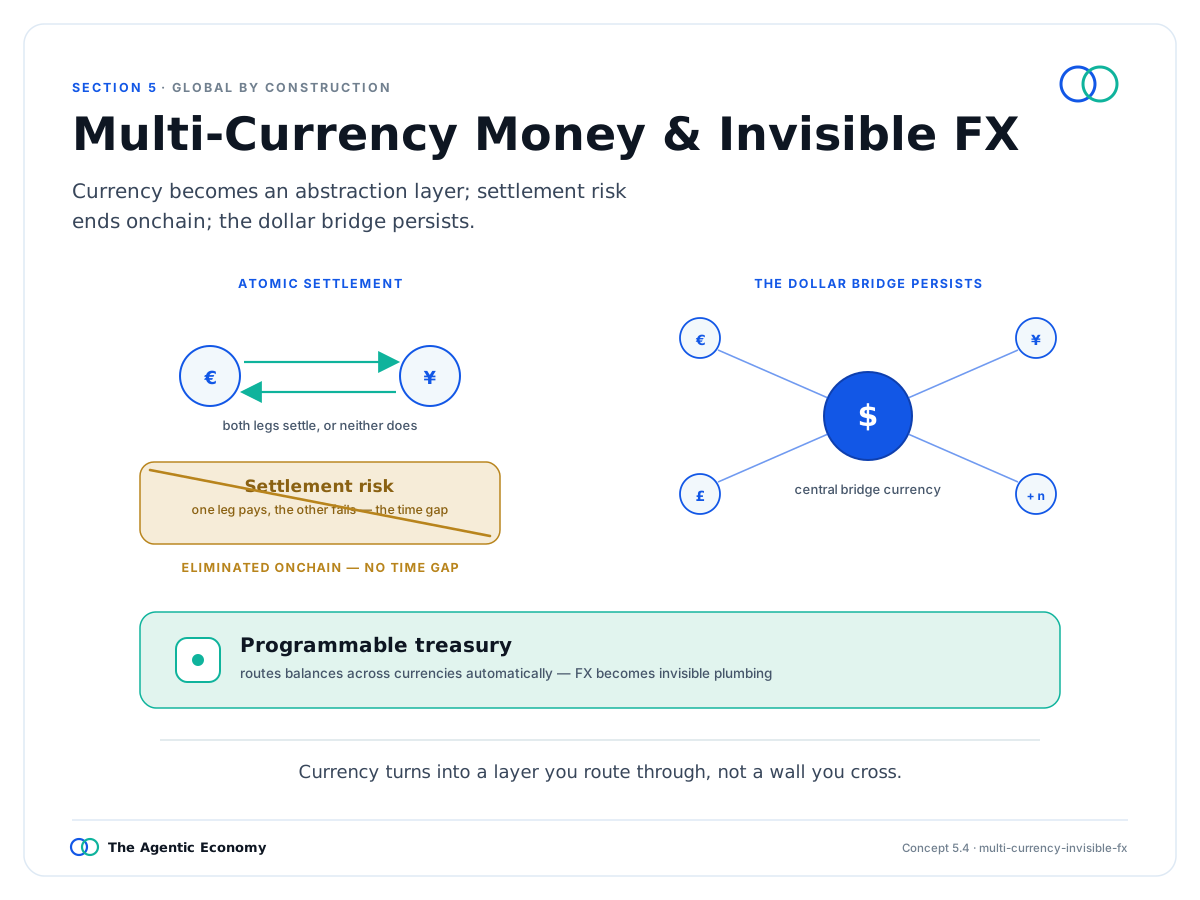
As every major currency comes onchain as a regulated, full-reserve stablecoin (and the legal scaffolding is being laid market after market), currency becomes an abstraction layer. An entity, or an agent acting for it, holds its own local money. The counterparty receives theirs. The conversion clears underneath, atomically, in a single settlement, at the best rate the market can offer in that moment. The developer, the agent, and the person at the end of it need not think about the exchange at all, in the way an application sending data across the internet never thinks about packets or routes. And the market that does the converting is not one mechanism but a plurality (request-for-quote order books, automated liquidity pools) competing and routing for best execution: a contestable microstructure rather than a monopoly utility.
The settlement property underneath is a real advancement. When the conversion clears atomically, both legs settle together or neither does, which eliminates the cross-currency timing gap: the risk that one currency leaves your account and the other never arrives. What it does not do is eliminate settlement risk altogether; it relocates it. The fiat boundary (funding from local bank money, or redeeming the stablecoin back into it) remains a separate, non-atomic event, and the integrity of any non-dollar stablecoin depends on the depth of its reserves and the liquidity of its redemption. So the agentic FX layer converts the opaque counterparty risk of the correspondent system into transparent, priceable peg-and-redemption risk: a risk one can see and measure, rather than one buried in a chain of foreign balance sheets.
The most consequential promise is reach: the long tail of currencies. A Paraguayan or Kenyan or Filipino currency is costly to transact globally today not because demand is absent but because the operational overhead of serving it through correspondent banking exceeds the value of the flow. Onchain, that fixed cost collapses toward zero, and a currency that was uneconomic to serve becomes serviceable: the same dynamic by which the internet, having driven the cost of distribution to nothing, served the long tail of niche products that physical economics had stranded. One important caveat on this is worth noting: liquidity is not like content. Standing ready to trade an obscure currency means committing real capital to inventory and bearing real risk on it, and that variable cost does not fall to zero. So the tail grows dramatically longer without becoming instantly complete.
In practice, the overwhelming majority of conversions route through the dollar as a bridge. A trade from one small currency to another clears as local-to-dollar and dollar-to-local, not as a native direct pair, because concentrating liquidity in a single vehicle currency is far more efficient than maintaining the impossible number of direct pairs a fully meshed market would require. The system is multi-currency at its endpoints and dollar-concentrated in its plumbing. The experience is genuinely local-to-local even as the value transits a dollar hub in between. The hub does not vanish, and its persistence has consequences for monetary sovereignty that the next part of this section takes up.
The same architecture reshapes how corporations and financial firms manage their treasury. A treasury that lives in onchain money is not a collection of accounts in many banks across many jurisdictions, painstakingly pooled. It is a single, global, always-on, policy-governed balance. Idle money becomes a legacy artifact: balances sweep into yield or credit continuously, as a standing condition rather than a nightly batch. People set the guardrails as programmable policy, while agents execute beneath. The same last-mile and FX-depth frictions still apply: a global treasury's reach into and out of local money still meets the licensing and liquidity constraints of the legacy edge.
5.5 Monetary Sovereignty, Reshaped
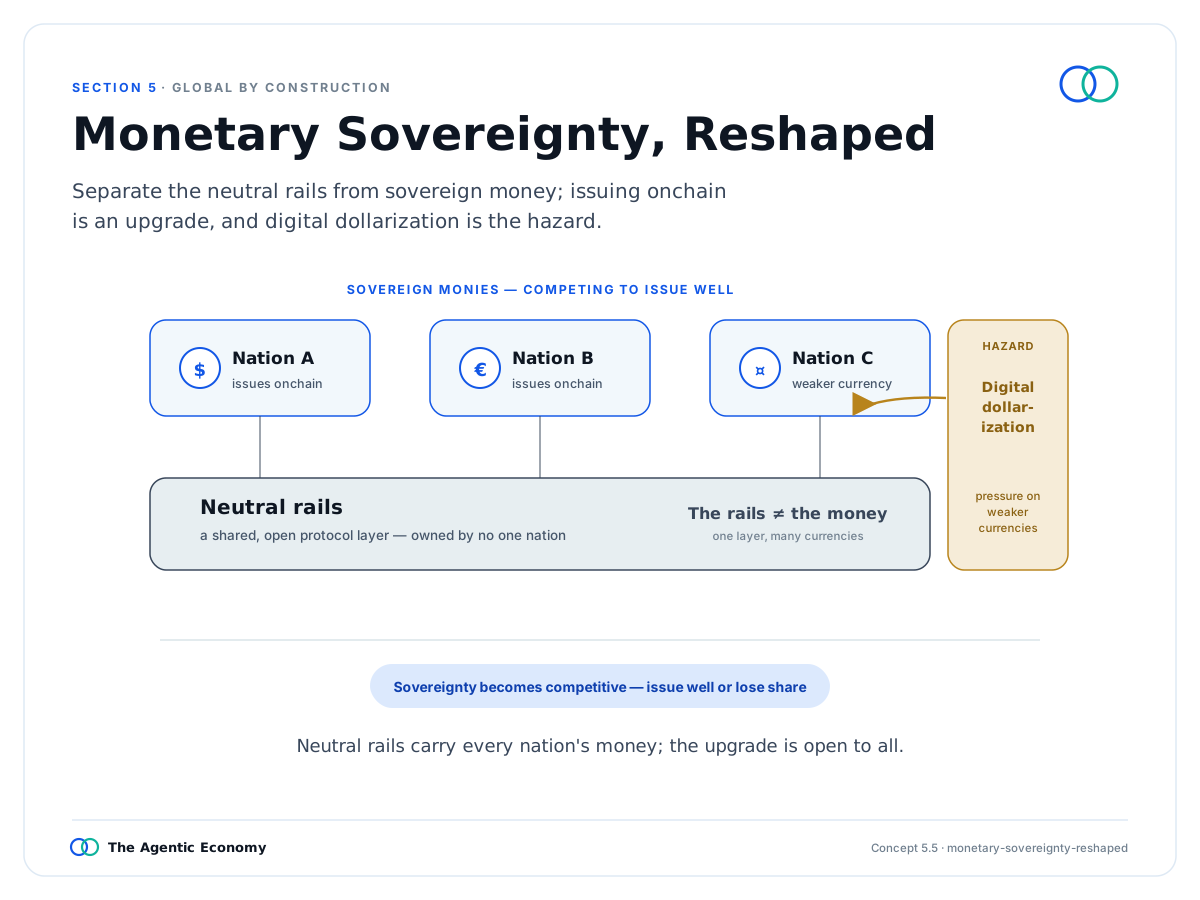
Monetary sovereignty is the worry that surfaces fastest once money moves on a neutral, global software layer. If value can settle anywhere in seconds, and one currency dominates cross-border routing, nations, especially smaller ones, would seem to be surrendering control over their monetary affairs. But that intuition rests on a conflation the architecture dissolves: sovereignty is reshaped, not surrendered.
Start by separating two things national banking systems have always fused: the rails on which money moves and the money that moves on them. The protocol layer is multi-stakeholder and jurisdiction-agnostic by design, owned by no single state. The money that travels across it remains jurisdiction-anchored: a regulated, full-reserve stablecoin is a claim denominated in some sovereign currency, issued under some country's law. The protocol is neutral. The money is not.
That distinction is fundamental. Neutrality of the protocol is not neutrality of the settlement asset. A dollar stablecoin is the regulated liability of entities answerable to one jurisdiction, and it carries, in effect, a foreign off-switch: it can be frozen or placed beyond a holder's reach by a government that is not the holder's own. But protocol neutrality is valuable precisely because it is the precondition that lets a nation issue its own currency on the same rails and reduce its dependence on a foreign asset with someone else's off-switch. Neutrality at the base is what makes sovereignty newly possible.
So bringing a nation's own currency onchain, as a regulated full-reserve instrument, is a sovereignty upgrade rather than a concession. A currency reachable only through a slow, costly lattice of correspondent relationships becomes globally programmable and directly usable by anyone. And the lever that actually constitutes monetary sovereignty, the authority to set the price of money in the domestic unit, stays with the central bank; what changes beneath the rate is the transmission plumbing, not the rate-setting power. This redefines sovereignty itself. The old definition was territorial: control the rails, police the borders. The more durable definition is competitive: sovereignty as the capacity to run sound money that earns usage, where currencies compete on credibility rather than enforce loyalty by walls.
The upgrade is genuine for currencies with deep markets and credible institutions; it is largely unavailable to the smallest and most fragile, which struggle to attract issuance or liquidity because few wish to hold them. But onchain rails lower the threshold for a small currency to reach usability in ways correspondent banking never allowed. The gap between these soverign currencies predates these rails; the question is whether they widen it or offer the first affordable path to close it.
The genuinely hard problem is digital dollarization. If citizens of a weak-currency economy can hold a dollar stablecoin as easily as a messaging app, currency substitution becomes frictionless as never before: draining the demand for domestic money, disintermediating local banks, and weakening a central bank that can print the local unit but not the dollars its citizens now hold. The architecture imposes discipline against this: when sounder money is a frictionless choice, unsound policy carries an immediate, visible cost. But the discipline is asymmetric. It falls on the weak currency, never on the issuer of the dominant one, which faces no comparable sanction precisely because its money is the asset everyone flees toward. That exorbitant privilege is real; it predates onchain money by generations and lives in the network effect, not the protocol.
Dollarization must be managed by "policy at the edge," not wished away: capital-flow measures, holding limits, and conversion rules expressed in code and enforced at the on-ramps and off-ramps. These are partial (the more permissionless the interior, the leakier the edge) but sharper and more observable than legacy models of enforcement. The threat is ceding the field to a foreign currency, which is the argument for issuing one's own local currency stableocin early.
A world of sound onchain currencies, deep liquidity, and effective boundary tools may be stable and even welfare-improving, but the history of capital-account liberalization teaches that the transition is where economies break, when substitution outruns the institutions and buffers that would make it safe. And these rails are arriving whether or not any single sovereign chooses them. So the choice is not between transition and no transition, but between one that is managed and sovereign-led and one that is forced and unmanaged. Sovereignty in the agentic economy is reshaped, and defensible only by those who run money worth holding.
5.6 Legacy Interoperability and Migration
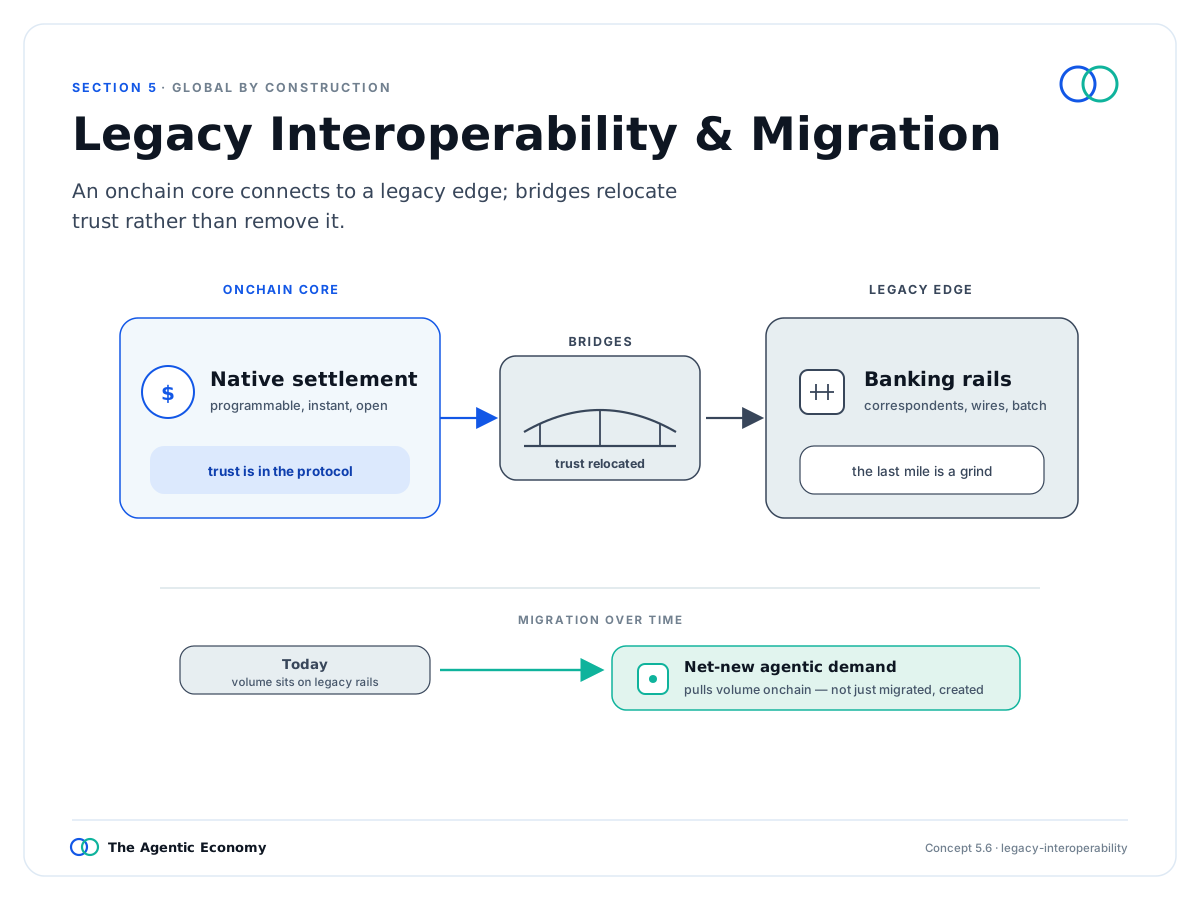
The agentic economy will not be born into a clean field. It arrives atop a planetary installed base of payment infrastructure (bank transfers, card networks, wires, e-money) that has run the world's money for decades and will not be swept away on any near horizon. This will not be a world of overnight displacement, a story this industry has told before and been wrong about. It is a new settlement substrate forming underneath the new value the agentic economy creates, while the legacy rails keep running the value that already exists, joined by bridges, with a boundary that moves slowly inward.
Onchain becomes the core (the native place where value is born and settled) for the flows that are new or that the old rails were never built to carry: cross-border value, programmable value, value that moves continuously around the clock, and above all value exchanged machine-to-machine by software agents in volumes and increments no human-paced rail was designed for.
Legacy becomes the edge: the last mile through which onchain value exits to reach endpoints that have not migrated. It is also worth noting that for much domestic, low-friction activity the incumbents are not standing still, as real-time account-to-account bank systems now deliver instant, cheap, final domestic settlement. The claim is not that those rails die. It is that the frontier of new value formation is onchain-native, while the legacy world keeps the installed base for years.
The two worlds are joined by bridges, and bridges must be described without illusion. A bridge is an intermediary, precisely the kind of trusted party the onchain model was meant to minimize. The point is that the trust is relocated and reduced, not removed. This is not the fragile, trustless cross-chain token bridge that produced crypto's worst losses; it is closer to a regulated clearing utility: licensed, capitalized, with conventional liability and resolution. The bridge is a systemic node, and its governance and resolution have to be engineered as deliberately as any clearing house.
The hardest part is the last mile, because cashing out to local money is where this industry has historically been weakest. A stablecoin balance is far more mobile than pre-funded accounts scattered across correspondents, but the endpoints remain a grind: a payout in a given country still depends on a banking partner, a license, and deep local liquidity at the moment of conversion, scarcest in precisely the emerging-market corridors where the cross-border case is largest.
Onchain does not, by itself, dissolve the correspondent-banking problem at the endpoints; it relocates it there. What a unified network changes is that the licensing-and-partnership burden becomes aggregatable: one network amortizing relationships, licenses, and local liquidity across many jurisdictions, rather than every firm building bilateral ties one country at a time.
The consumer and merchant surface also embraces and extends into the onchain core. Tokenized card credentials let value funded onchain reach existing merchant acceptance, but they still ride the incumbent card rails, with their scheme rules and fee economics intact. The distinction is between settlement-layer migration, which is likely, and acceptance-layer migration, which is contested and may never fully happen. A durable equilibrium in which stablecoins merely fund the same card networks, with the incumbents keeping the acceptance surface and the rents, is a genuine possibility, though as the agentic economy unfolds and more services are fulfilled using onchain money, it seems clear that the ultimately acceptance-layer rails will succumb to the new onchain environment.
What ties the migration together is that agentic commerce is net-new demand: value exchanged by software agents that no incumbent rail was built to serve, riding the secular growth of AI rather than depending on the zero-sum conversion of incumbents. Onchain need not win an argument with the card networks to become the substrate of the agentic economy. It need only be the place that the agentic economy can natively run. Coexistence will continue for a long time; but the substrate is being laid even as the old world keeps running on top of it, and the boundary between them moves, steadily, in one direction.
5.7 The Equalizing Dimension and Its Counterweight
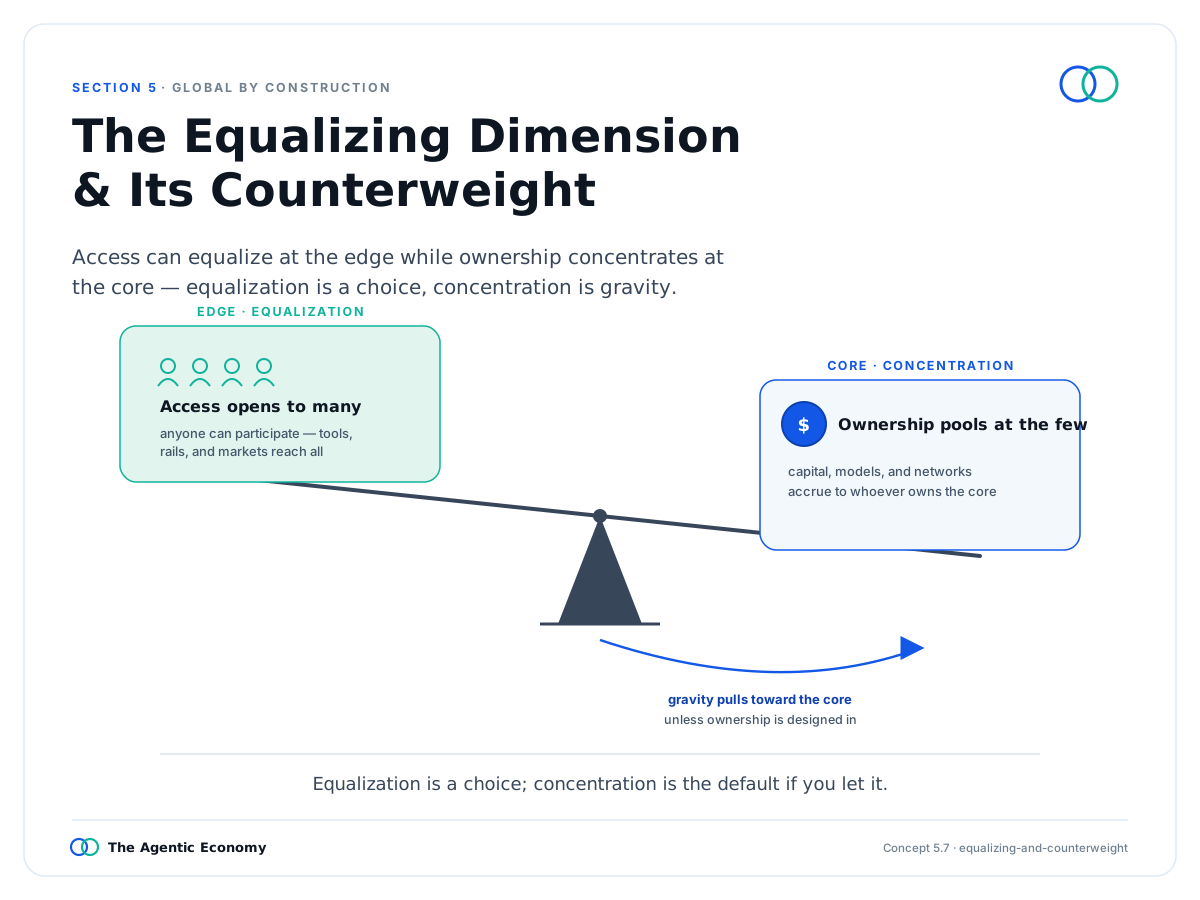
Every property that makes the agentic economy powerful cuts both ways. Being borderless opens the whole world to a creator in a small market, and opens that small market to the whole world. Permissionless access removes the gatekeeper who kept out the unbanked, and removes the gatekeeper who protected the local incumbent. Zero marginal cost lets anyone serve everyone, and lets the best-funded player serve everyone first. The design is two-sided: radically equalizing and powerfully concentrating at the same time, from the very same features. Section 8 takes this up in full.
The equalizing case is real, and in places absolute. Earlier waves of digital opportunity were egalitarian in rhetoric but gated in practice. Distribution needed an app-store reviewer's approval. Payments needed a bank. Capital markets needed accreditation. And the global financial system ran on correspondent banking that left much of the world out. An on-chain agentic economy can have no gatekeeper at the protocol level. No one's permission is needed to hold sound money, to transact, to supply or consume credit, or to sell agent-produced work into a global market. For the genuinely excluded, that's the difference between zero and one. And access to a stable store of value, independent of a failing local currency, matters most to the people a high-inflation economy has served least.
The counterweight is just as real. Removing the friction of borders, currencies, and local licensing works in both directions. It isn't a one-way gift to the periphery. The world reaches the small market as easily as the small market reaches the world, and it arrives better-funded, with better agents and lower costs. Local players used to survive on the protection created by distance, language, currency, and regulation. Strip that away, and they face winner-take-all competition they're set up to lose. And winner-take-all is the baseline here, not just a risk. Money is the purest network-effect good there is, so one dominant settlement asset tends to become the default. And frontier AI capability is gated by capital at a scale the open web never required. The open web ended with a handful of giants. The same gravity operates here.
The two outcomes aren't evenly matched. Concentration is the default: it's what these features produce on their own, reinforced by the deepest patterns of platform economics. Equalization is the buildable alternative. It only happens if specific things are built and chosen: open infrastructure at the core layers that would otherwise collect tolls, ownership distributed by design rather than left to capital's pull, and policy that stops gatekeepers from re-forming at the new chokepoints, namely the model, the dominant issuer, the identity layer, and the bridge. Equal access is not the same as equal outcomes. That a creator anywhere can reach the global market says nothing about who captures the profit. The honest claim is that the floor rises, not that the gap closes. The outcome is a choice, made through ownership structure and policy, and for the first time the technology has put the better outcome within reach of deliberate design. The global layer doesn't settle this question. It sharpens it and hands it to Section 8, where the choice actually gets made.
An economy that's global by construction can't be only a technical or economic fact. It's unavoidably a geopolitical one, and three things follow. First, the base infrastructure has to be technologically neutral and governed by a wide set of stakeholders, not owned by any one state, because a planetary economic operating system controlled by a single power would be neither trusted nor stable. Second, when a major government enshrines its currency as regulated digital money, the consequences are profound and lasting. It accelerates the migration of value onto these rails and forces every other government to compete, adapt, or resist. Third, economic velocity raises the cost of conflict. A world whose commerce is woven together at machine speed has, built into its very plumbing, a reason for its participants not to tear it apart. That's the most hopeful of the three implications, and the least certain. All of these carry forward to Section 8.