The Convergence and the Decomposition of the Firm
The Agentic Economy is a personal work authored by Jeremy Allaire in his individual and personal capacity. Jeremy Allaire is the Chairman, Co-Founder, and CEO of Circle Internet Group, Inc., a company whose current or future products and platform may relate to topics discussed in this work. The views, opinions, and arguments expressed are solely his own. They do not represent the views of Circle Internet Group, Inc. or any of its affiliates, subsidiaries, directors, officers, employees, or investors, and should not be construed as a statement made by or on behalf of Circle. Although Circle is making the link available for convenience, the treatise is not a Circle statement, policy position, product announcement, forecast, or endorsement, and it has not been adopted or approved by Circle Internet Group, Inc., its affiliates, board of directors, or officers.
This work contains forward-looking statements, projections, and opinions about technological, economic, and regulatory developments. These reflect the author’s personal assessment and involve inherent uncertainty. Actual developments may differ materially. Nothing in this work constitutes investment, financial, legal, or regulatory advice, and no portion should be relied upon as such.
Every major platform shift of the internet era arrived the same way. Not as a single invention, but as several technologies that had matured separately and suddenly came together. The web was one such convergence. It needed usable graphical interfaces on commodity hardware, the deregulation that opened the internet to commerce, modems fast enough to make the connection usable, and an open software layer of pages, links, and servers. None of those alone would have made it. Digital media was another convergence, when broadband investment met new media formats and the wireless networks that carried them. Mobile combined cheap cameras and sensors, location, the touch interface, and mobile broadband. The cloud commoditized first software and then hardware. Social platforms were what happened once mobile put a connected device in every hand.
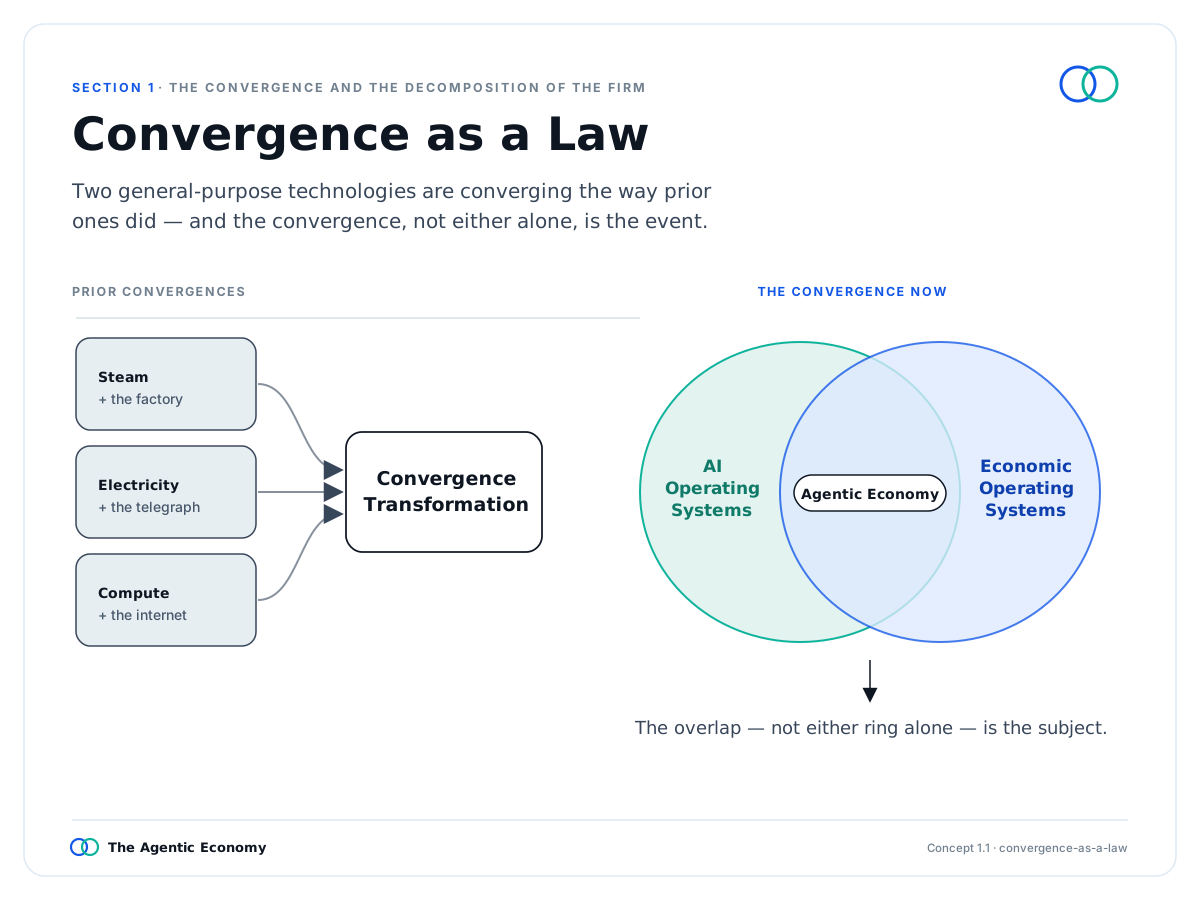
The pattern beneath all of them recurs reliably. When capabilities converge, the marginal cost of some previously expensive activity collapses toward zero. And when that cost collapses, the velocity of that activity explodes. The web exploded the velocity of published information. Mobile and social did the same for human communication. The cloud did it for the creation and delivery of software.
Two new operating systems are now converging, and they apply that same mechanism to the two things the internet never managed to digitize natively: intelligence, and economic activity itself. The first is an operating system for intelligence: artificial intelligence, in the form of foundation models and the cloud-hosted agentic systems built on them. The second is an operating system for the economy: blockchain networks, on which value, contracts, and coordination can be expressed and executed in software. Each drives the marginal cost of its domain toward zero. One collapses the cost of cognition and work. The other collapses the cost of transaction, settlement, and coordination. And like every prior shift, the two reinforce each other. Intelligence makes economic activity possible to conduct at machine speed, and an economic substrate lets machine intelligence transact, exchange value, coordinate and execute contracts. This is more than the meeting of two trends. It is a single phenomenon, and the destination of this work is a claim earned gradually across these pages: that the agentic economy and the onchain economy are not neighbors but the same economy, converging in a powerful force that will transform the global economic system.
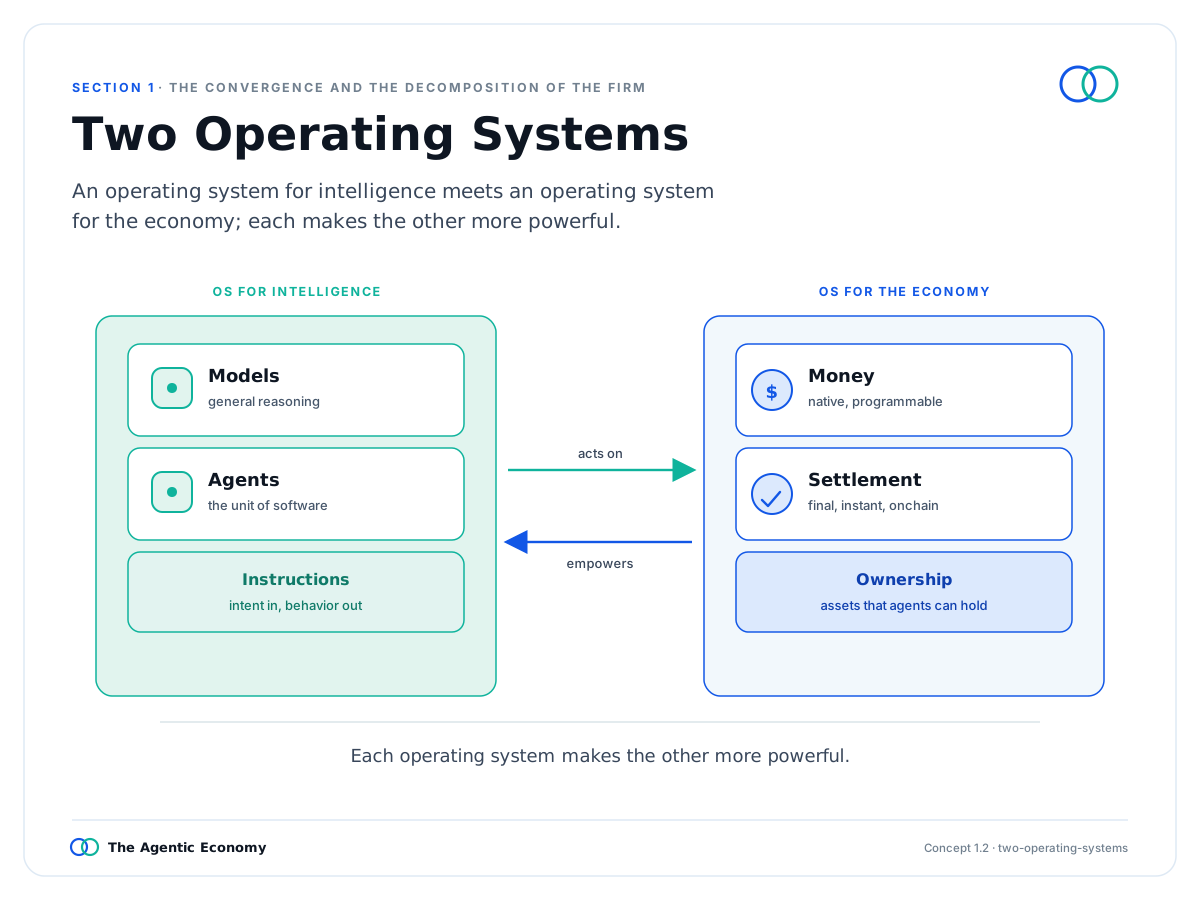
Start with the operating system for intelligence, because it sets everything else in motion. The term means something specific: the capabilities of frontier foundation models, together with the reasoning and agentic infrastructure that lets them execute work at scale, exemplified today by platforms such as Claude and Claude Code, or OpenAI and Codex. These are a new kind of compute machine. You do not program them in the old sense. You instruct them, in language, to produce things and carry out work. The atomic unit of that work is the agent: a reasoning process dispatched against a task. A conventional operating system abstracts hardware and exposes deterministic programs you drive through explicit interfaces. The operating system for intelligence abstracts cognition. It is operated through natural-language instruction, it runs non-deterministic reasoning rather than fixed logic, and it takes the agent, not the function call, as its unit of execution. This reframes software itself, from instructions a human wrote and a machine executes literally, to work a human delegates to a reasoning machine. That shift is what makes the next move possible.
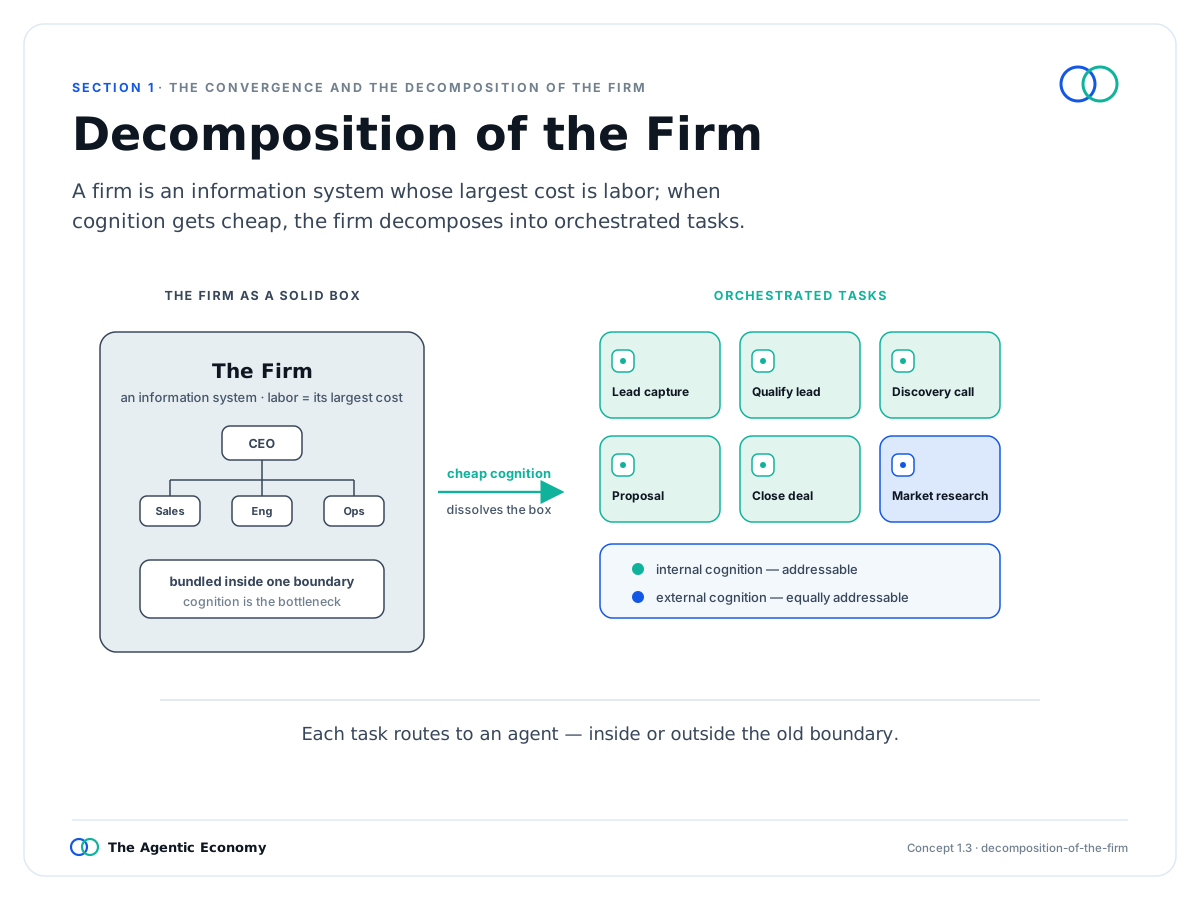
For the first time, the fundamental tasks of economic production can be broken apart and rebuilt as agentic skills. To see why that matters, look at what a corporation actually is. Beneath the brand and the buildings, a firm is an information system organized around a familiar set of functions: product and engineering, marketing, sales, talent, finance, legal and compliance, operations, customer support. And what it costs to run that system is overwhelmingly labor. Across the economy, labor is the single largest operating expense, commonly a quarter to a third of revenue, and far more in service businesses, where it routinely runs from a third to half of costs and, in low-capital operations, well past that. In knowledge and technology firms the point becomes nearly total. The spending that isn't capital is salaries, for engineers, salespeople, marketers, executives, lawyers, and finance staff. Such a company is, in substance, organized cognition with a logo attached. A second great pool sits beyond the payroll: outside professional services, the consultants, lawyers, accountants, agencies, and outsourced specialists that are simply organized labor rented from beyond the firm's walls. Both pools, internal and external, are organized human cognition. That is the exact cost and capability the operating system for intelligence targets.
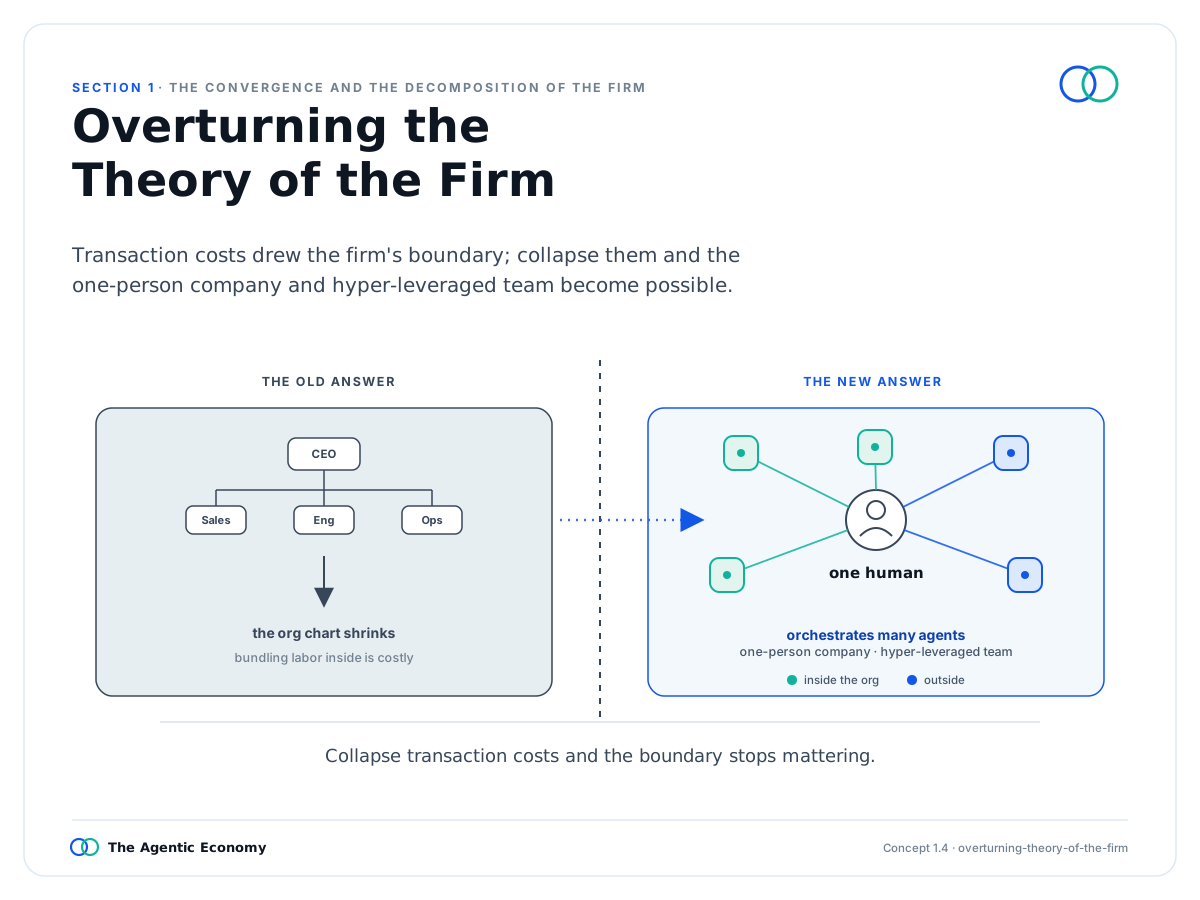
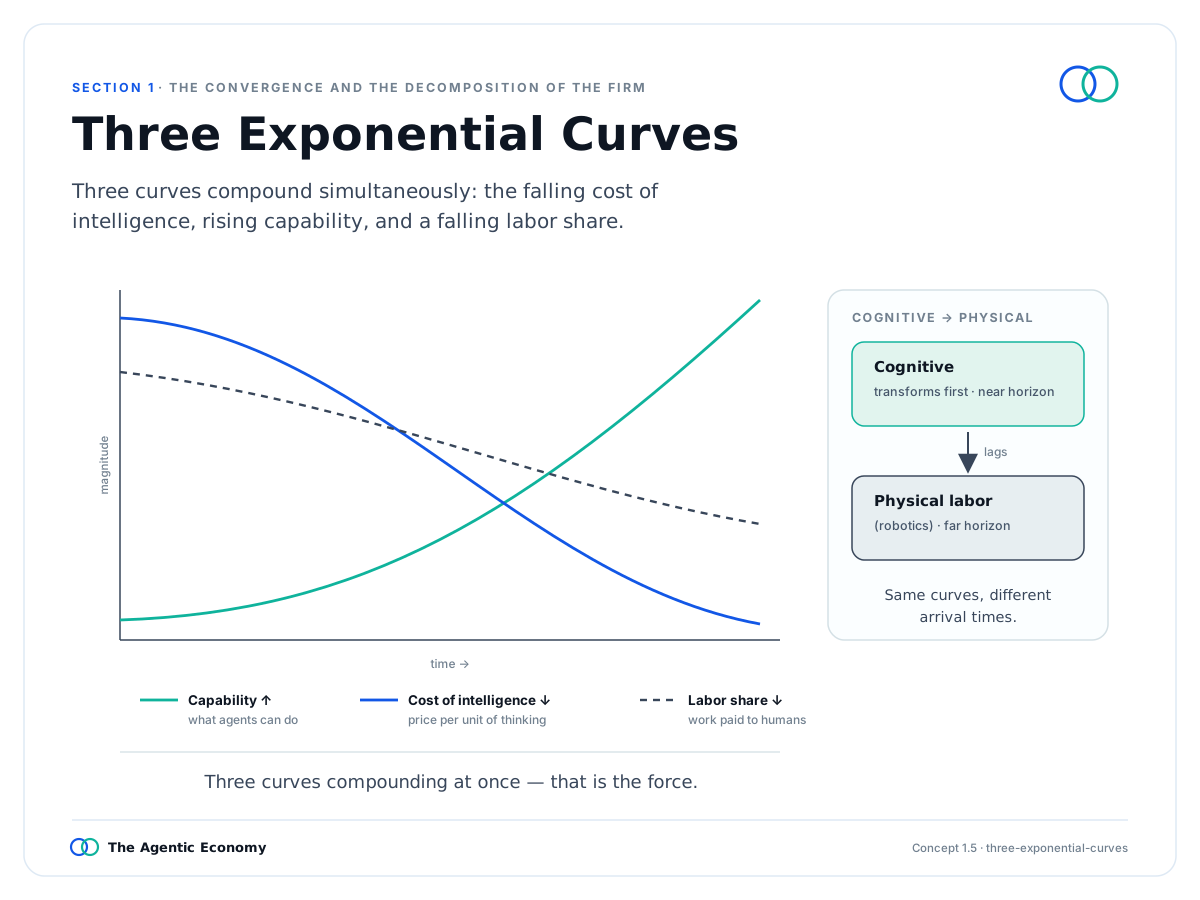
This is why the agentic economy overturns the classical theory of the firm. Economists have long explained why companies exist by pointing to transaction costs: coordinating, contracting with, and trusting external labor is expensive, so a firm internalizes the work it is cheaper to make than to buy. The boundary between what happens inside the company and what is bought outside is drawn by the cost of coordination. When every unit of non-physical work can be performed by a discoverable, contractable, instantly settleable agent, those coordination costs collapse, and the boundary loses its grip. The vivid consequences are the one-person company, where a single human orchestrates a roster of agents to do what once required departments, and the hyper-leveraged small team inside a large firm that executes at a scale its headcount could never support, reusing agentic skills built both inside and outside the organization. The economics compound, because three exponential curves move at once. The labor share of operating cost falls as cognition shifts to agents. The cost of running those agents falls, with the price of equivalent machine intelligence dropping on the order of tenfold a year. And the capability of that intelligence rises across nearly every benchmark at the same time. Cheaper to run, more capable, and absorbing more of the cost base: the three multiply, and the productive potential is enormous.
This decomposition is not uniform. It is appearing first in software engineering, because today's models are exceptionally strong at understanding and writing code. It is spreading in parallel across the information-and-coordination-heavy functions, marketing, sales, support, and much of legal, finance, and compliance, wherever the work is the crafting, targeting, analyzing, and presenting of information. The most repeatable, information-dense tasks fall first, but much of this advances at once rather than in a neat queue. Physical labor is the furthest off. Robotics is delivering augmentation in heavy industry and assembly, but the hard problems of physical production, the physical sciences, and complex logistics remain years away, likely a decade or more, even as AI's own progress begins to bend the robotics curve. The cognitive decomposition is already underway and on a compounding curve, and the reasonable expectation is a sharp acceleration over the next two to three years. The trajectory is exponential, and exponentials are routinely underestimated in their early, deceptively gentle stretch.
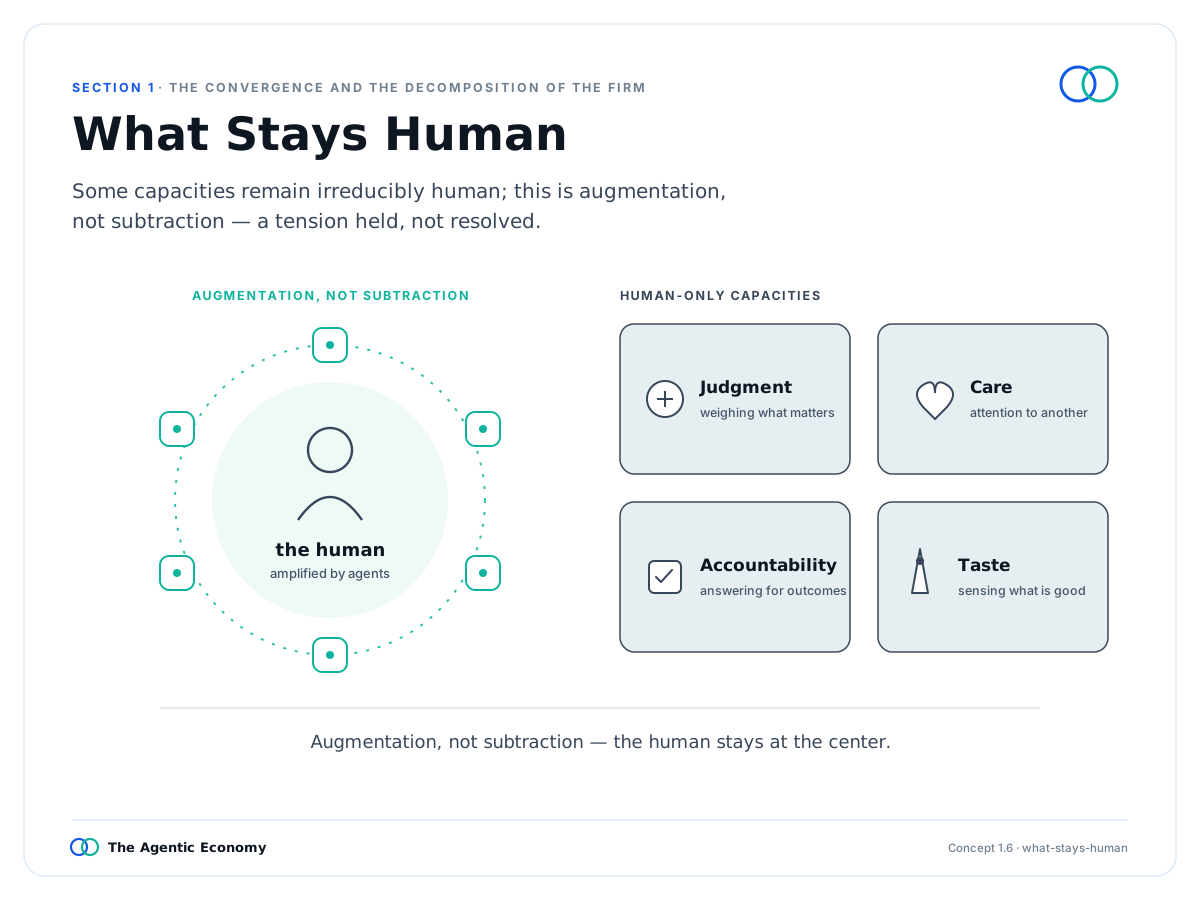
It would be a mistake to read decomposition as the simple subtraction of people. The more accurate picture is augmentation as much as replacement. Human creativity and inventiveness are magnified when paired with deep agentic skill. People take on broader, more cross-functional and inter-disciplinary roles, move between focuses far faster than before, and do things that were previously inconceivable for an individual or a small team. Certain capacities remain irreducibly human: the work of emotional relationships and direct human engagement, the exercise of critical judgment over agentic processes, and the responsibilities of governance and accountability that cannot be delegated to a machine. There is a real tension here. At the level of the individual, this is a story of magnification, of people made far more capable. At the level of the whole economy, it raises a hard question about the share of output that flows to labor at all. Both are true at once. The serious objection is that magnification for individuals can coincide with a falling labor share for the economy, and a later part of this argument reconciles them directly, through ownership. For now it is enough to say that "what stays human" is not a vestige but a transformed and, in important ways, enlarged surface.
The firm, then, decomposes into intelligence, into agentic skills oriented around the work of creating, delivering, and servicing a product or a service. But a decomposed firm raises a new question: how are all those skills reassembled into coordinated work, and how are the economic relationships among them, inside the company and increasingly beyond it, expressed, enforced, and settled? Decomposition into agents is the beginning of the story. Assembly, coordination, and the economic substrate that makes them transactable are the rest of it. That is where this argument turns next, and it is the path by which the operating system for intelligence and the operating system for the economy are revealed, in the end, to be one and the same.